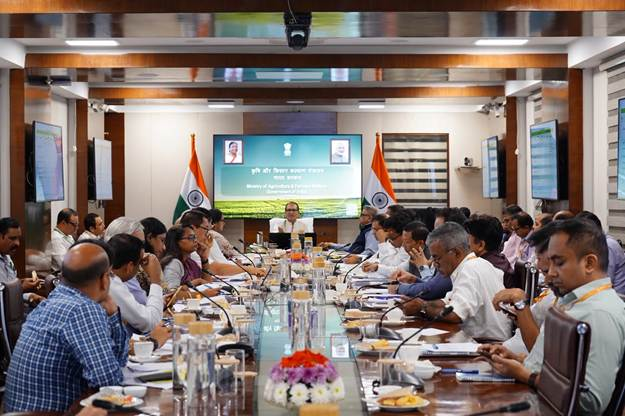
The Ministry of Agriculture’s first comprehensive monthly review meeting was held at Krishi Bhawan in New Delhi, presided over by Union Agriculture Minister Mr. Shivraj Singh Chouhan.
Prime Minister Narendra Modi holds a clear vision: the benefits of various schemes must be reflected in the lives of farmers, not merely on paper—Union Minister Mr. Shivraj Singh.
The digital revolution marks a historic milestone: over 1.077 billion “Farmer IDs” have been created nationwide, ensuring scheme benefits reach farmers directly—Mr. Shivraj Singh.
A nationwide “Save the Fields” campaign will launch this month; Union Agriculture Minister Mr. Shivraj Singh Chouhan has directed that thorough preparations be made to maximize benefits for farmers.
While reviewing projects related to pulses and oilseeds, Minister Chouhan stated, “We will make India fully self-reliant in edible oils and pulses.”
Natural farming has garnered immense support: targets have been surpassed, with 2.732 million new farmers and 1.285 million hectares of cultivated land added, alongside the deployment of 33,000 agricultural volunteers.
Minister Chouhan expressed confidence in the Prime Minister’s Agricultural Development Scheme (PM-RKVY): “Under Prime Minister Modi’s leadership, states will not face a shortage of funds for agricultural development.” Farmer confidence in the Prime Minister’s Crop Insurance Scheme (PMFBY) has grown, with enrollment rising by 23% to over 28.3 million; Minister Chouhan
has directed that the claims settlement process be expedited.
A new initiative aims to bridge the gap between laboratories and fields: Krishi Vigyan Kendras (KVKs), the Agricultural Technology Management Agency (ATMA), and agricultural universities are to collaborate as “one team” to work together in the fields. The Agriculture Infrastructure Fund (AIF)
is providing loans worth ₹1.01 trillion to build modern infrastructure in villages, while a record 3 million farmers have joined Farmer Producer Organizations (FPOs)—Mr. Shivraj Singh Chouhan
stated. The Makhana Vikas Mission (Fox Nut Development Mission) has yielded remarkable results, tripling farmers’ earnings; Mr. Shivraj Singh has directed that the quality of training on the ground be verified. Union Agriculture Minister Mr. Shivraj Singh Chouhan addressed states and regions that have been slow to act, stating: “Prime Minister Modi’s schemes benefit every single farmer; I will communicate with the Chief Ministers of the states if necessary.”
The central government’s agricultural policy is guided by principles such as providing direct financial assistance to farmers, ensuring easy access to institutional credit, empowering farmers, developing modern rural infrastructure, promoting natural farming, strengthening Farmer Producer Organizations (FPOs), and achieving complete self-sufficiency in pulses and oilseeds. To effectively implement these goals, the Ministry of Agriculture held its first comprehensive monthly review meeting today at Krishi Bhawan, chaired by the Union Minister for Agriculture and Farmers Welfare and Rural Development, Shivraj Singh Chouhan. Citing Prime Minister Narendra Modi’s philosophy of “changing lives, not just files,” Minister Chouhan articulated that the government’s objective is not merely to boost production but also to create greater economic opportunities for farmers by eliminating dependence on imports. During this high-level meeting, it was decided that the operations of all departments, divisions, and national missions under the Ministry would undergo regular monthly reviews, alongside an assessment of monthly financial status and statements. Specific targets will be established. Senior officials, including Agriculture Secretary Mr. Atish Chandra, attended the meeting.
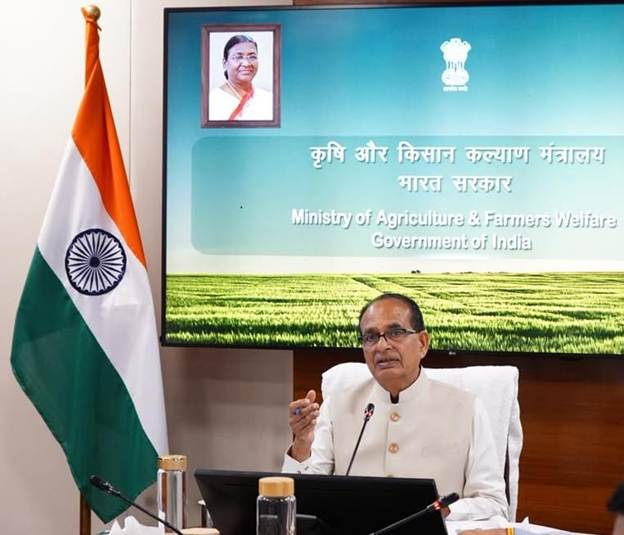
The review meeting highlighted several historic achievements, such as the creation of over 107.7 million unique “Farmer IDs” under the “Digital Agriculture Mission,” the surpassing of national targets for pulse and oilseed production, the unprecedented promotion of natural farming practices, and a significant 23% expansion in crop insurance coverage. Union Minister Shivraj Singh commended all these accomplishments. Additionally, the meeting finalized the framework for the nationwide “Save the Soil Campaign” (Khet Bachao Abhiyan), set to launch this month, which aims to protect farmland soil and crops. While assuring states of continued approval for projects under the “Pradhan Mantri Rashtriya Krishi Vikas Yojana” (Prime Minister’s National Agriculture Development Scheme), Union Minister Shri Chouhan also issued strict directives to lagging states and regions to eliminate administrative laxity.
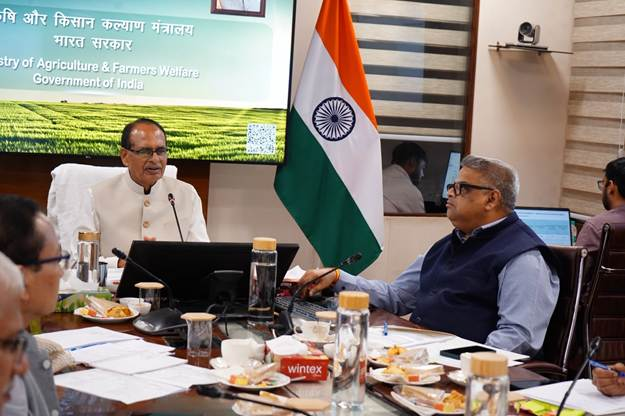
“Save the Farm Campaign” to Launch This Month; Farmers Set to Reap Maximum Benefits
During a review meeting, Union Minister Mr. Shivraj Singh Chouhan announced a major nationwide campaign aimed at saving farmland and addressing issues such as deteriorating soil health, poor crop residue management, and the overuse of chemical fertilizers. He stated that an intensive initiative known as the “Save the Farm Campaign” (Khet Bachao Abhiyan) would launch nationwide on the 22nd of this month. The Minister instructed officials to ensure the campaign is designed and implemented effectively so that farmers in every village can benefit directly. He emphasized that saving farmland is not merely an agricultural issue but is vital to the nation’s future and the nutritional well-being of future generations. Under this initiative, agricultural scientists and field staff will visit farms to provide practical guidance to farmers on soil testing, organic matter conservation, avoiding crop residue burning, and balanced nutrient management.
A New Chapter in the Digital Revolution: 107.7 Million Farmer IDs Ready
Progress on the digital agriculture initiative was presented during the review meeting. The program aims to digitally integrate 140 million farmers nationwide; so far, digital farmer IDs have been successfully created for over 107.7 million farmers. Union Minister Mr. Shivraj Singh Chouhan described the initiative as the most powerful tool for economically empowering the nation’s small and marginal farmers. This unique digital identity serves as a transparent channel for the direct transfer of subsidies, low-interest institutional loans (Kisan Credit Cards), Minimum Support Price (MSP) procurement payments, crop insurance payouts, and disaster relief funds into farmers’ bank accounts—eliminating middlemen and saving time otherwise spent on paperwork.
With the expansion of digital infrastructure, a “Digital Crop Survey” conducted during the current Kharif season (monsoon cropping season) has successfully digitized surveys for over 267.3 million farm plots, enabling the direct acquisition of accurate crop data via satellite and mobile applications. Meanwhile, under the “National Soil Mapping Program,” 100% digital mapping of 8.03 million hectares of land has been completed. Union Minister Shivraj Singh directed that in states where progress on farmer identification and digital surveys has been slow, special training sessions should be organized to bring all farmers onto the digital platform as soon as possible.
Self-Sufficiency in Pulses and Oilseeds: Nation Surpasses Targets
Initiatives aimed at reducing import dependency have yielded encouraging results. Under the national pulse self-sufficiency program, the cultivated area, total production, and yield per hectare for pulses in the 2025–26 fiscal year all exceeded national targets. National pulse production reached a record 27.409 million tonnes, surpassing the target of 26.6 million tonnes, while the sown area reached 28.646 million hectares, exceeding the 28.3 million hectare target. Union Minister Shivraj Singh stated that current climatic and policy conditions are highly favorable for pulse production, making this a historic national achievement.
Similarly, under the edible oil and oilseed development program, oilseed production in 2025–26 reached 43.059 million tonnes, exceeding the target of 42.7 million tonnes; the sown area reached 30.88.6 million hectares, also surpassing the target. Domestic edible oil production rose from 12.175 million tonnes in 2023–24 to 12.996 million tonnes in 2025–26. Meanwhile, under the oil palm development program, the target for new plantation area in 2026–27 was 119,000 hectares; approximately 50,000 hectares were covered in just the initial months, meaning about 42% of the annual target was achieved in the early stages.
Unprecedented Expansion in Natural Farming, Horticulture, and Farmer Producer Organizations (FPOs)
Results from the national natural farming program have far exceeded expectations. In 2025–26, a total of 2.093 million farmers adopted natural farming—surpassing the target of 1.875 million—and the area under natural farming reached 1.032 million hectares, exceeding the target of 750,000 hectares. To date, 2.732 million farmers across the country have adopted natural farming, covering an area of 1.285 million hectares. More than 33,257 “Krishi Sakhis” (agricultural partners) and community resource persons have been deployed to villages to promote this initiative. During a visit to Andhra Pradesh, Minister Shivraj Singh noted that local farmers are directly benefiting from natural farming, even amidst low rainfall.
In the horticulture sector, the country’s production reached a record high of 370.84 million tonnes, surpassing the 360-million-tonne target set by the “Mission for Integrated Development of Horticulture” (MIDH). Under this scheme, 187 new nurseries were established—exceeding the target of 50—and 190,000 hectares of new orchards were planted, surpassing the 100,000-hectare goal. Meanwhile, under the “10,000 Farmer Producer Organizations (FPOs) Scheme,” the number of participating farmers reached 3.011 million, significantly enhancing collective market access for smallholders; the average annual turnover of these FPOs rose from 3.8 million rupees to 14.176 million rupees.
PM-RKVY and AIF: Ample Funding for Rural Infrastructure
While reviewing the Pradhan Mantri Rashtriya Krishi Vikas Yojana (PM-RKVY), Union Minister Mr. Chouhan clarified that the central government continues to approve new projects while balancing state priorities and farmers’ interests. To date, the project approval committee has sanctioned 664 new projects for the 2026–2027 period, including 314 facilities such as laboratories, warehouses, and farm machinery rental centers, as well as 303 projects focused on seed production and expanding cultivation areas. Out of a total allocation of 85.5 billion rupees, 31.518 billion rupees in funds have already been released. Union Minister Mr. Shivraj Singh assured that under the leadership of Prime Minister Mr. Narendra Modi, the central government would ensure no shortage of funds for the comprehensive development of the agricultural sector.
Meanwhile, under the Agriculture Infrastructure Fund, over 225,000 projects have been approved with total loans exceeding ₹1.015 trillion (₹1,01,502 crore) for the construction of modern warehouses, cold storage facilities, primary processing centers, and farm machinery rental centers in rural areas, involving a total investment of over ₹1.73 trillion. Additionally, the AgriSURE Fund, established to support emerging agricultural startups and foster innovation among rural youth, has committed ₹245 million (₹24.5 crore) in funding.
Crop insurance coverage has grown by 23%, alongside rising awareness regarding soil health and micro-irrigation.
Union Minister Mr. Shivraj Singh highlighted the growing trust farmers place in the Pradhan Mantri Fasal Bima Yojana (Prime Minister’s Crop Insurance Scheme). He noted a 23% increase in the number of insured farmers this season—rising to 28.3 million from 23 million in the previous Kharif season. The insured area expanded to 29.7 million hectares, and the sum insured surged from ₹1.45 trillion to a record ₹1.86 trillion. Minister Singh directed that the claims settlement process must be completely transparent, all claims processed promptly, and grievances resolved within the stipulated timeframes.
During a review of the Soil Health Scheme, it was reported that over 1.6 million soil health cards have been issued to date, and 1,140 mini-testing laboratories have been set up in PM-SHRI schools. Union Minister Mr. Chauhan expressed satisfaction with the heightened awareness among farmers regarding field-level soil testing and the balanced use of fertilizers, noting that the scheme’s reach would be further expanded by integrating it with the Khet Bachao Abhiyan (Save the Fields Campaign). Meanwhile, under the “Per Drop More Crop” micro-irrigation scheme, ₹15.0463 billion has been invested to bring 486,000 hectares of land under micro-irrigation systems.
Integration of Extension Mechanisms: KVK, ATMA, and Universities Working as “One Team”
Mr. Shivraj Singh Chouhan directed a major overhaul of the extension system to take agricultural research findings directly from the laboratory to the farmers’ fields. He stated that the Agricultural Technology Management Agency (ATMA), Krishi Vigyan Kendras (KVKs), and state agricultural universities should not operate in silos but rather collaborate as a single “team” to ensure that technical guidance from scientists directly benefits farmers, thereby bridging the gap between “lab and land.” Furthermore, while reviewing the ATMA scheme, the Union Minister noted that the traditional model of farmers’ markets needs to change; instead, these markets should be organized in a more practical, modern, and participatory manner to ensure the direct involvement of as many farmers as possible.
During a review of specific crops, it was noted that the value of farmers’ produce has tripled under the “Makhana Vikas Yojana” (Makhana Development Scheme). In light of this, Union Minister Shivraj Singh called for expanded training and strengthened quality checks. The meeting also emphasized accelerating the “National Bamboo Mission,” the “National Beekeeping and Honey Mission,” the “Kapas Kranti” scheme (aimed at boosting cotton productivity), and the “Mission Organic Value Chain Development for North Eastern Region” (MOVCDNER).
Clear instructions were issued to states and districts lagging in implementation: communicate directly with Chief Ministers if necessary.
A review was conducted regarding the ranking of districts based on 74 output indicators under the “Pradhan Mantri Dhan Dhanya Krishi Yojana.” The national average score improved from 18.85 in April to 46.89 in August. While commending the top ten performing districts, Union Minister Shivraj Singh expressed concern regarding districts that consistently rank low or show laxity in scheme implementation. He made it clear that such a situation is unacceptable in underperforming districts. He directed officials to apprise these districts and the respective state agriculture ministers of the situation, stating that he would, if necessary, personally discuss the matter with state Chief Ministers to resolve the impasse and ensure equitable benefits for farmers across the country.
During the review meeting, Union Minister Shivraj Singh Chouhan issued clear, timely, and result-oriented guidelines to all participating senior officials and program heads. He stated that preparations for the “Save the Fields Campaign” (Khet Bachao Abhiyan), set to launch this month, must be fully in place; scientists, experts from Krishi Vigyan Kendras (KVKs), and field staff should go directly to the fields to ensure that the maximum number of farmers benefit from proper soil conservation, crop residue management, and soil fertility enhancement techniques. Minister Chouhan emphasized financial discipline, instructing departments and planning divisions to monitor both financial and physical progress on a monthly basis. Expenditure and field activities should not be deferred to the final months of the fiscal year but should proceed according to prescribed quarterly targets. Similarly, in states where the implementation of digital identification and digital crop surveys is sluggish, awareness campaigns should be prioritized in coordination with state governments to ensure all eligible farmers are covered; the Prime Minister’s vision of digitalization must not leave farmers behind. Union Minister Shivraj Singh ordered strict adherence to transparency to completely eliminate financial leakage. He stated that all eligible farmers should be immediately enrolled in the “Prime Minister’s Farmer Income Support Scheme” (PM-KISAN), while any ineligible beneficiaries must be removed from the list. Furthermore, regarding the procurement system under the “Prime Minister’s Community Health Worker Scheme” (PM-ASHA), he directed that actual procurement be assessed monthly and that the practice of repeatedly extending procurement deadlines beyond the stipulated three-month period be halted, thereby completely eliminating financial leakage in the procurement process. Regarding the “Pradhan Mantri Fasal Bima Yojana” (Prime Minister’s Crop Insurance Scheme), he directed that the claims settlement process for farmers must be transparent, free from unjustified delays, and that all farmer-related grievances must be resolved within the stipulated timeframes.
Union Minister Mr. Shivraj Singh further clarified that senior officials should not rely solely on paper reports but must conduct on-the-ground field visits to verify the practical impact of “Makhana Mission” training, natural farming models, soil health cards, and farmers’ markets. He emphasized the need for regular follow-ups with district administrations and state agriculture ministers in regions where performance rankings are consistently declining; the goal is to bridge regional disparities and ensure that all welfare schemes initiated by Prime Minister Narendra Modi reach vulnerable small and marginal farmers.